 COVID-19 rapid test for home use (nasal swab)
Price on request

A rapid test for the qualitative detection of novel coronavirus antigens in human nasal swab specimens.
Read the full product description ↓We will confirm the price for this selection in your quotation.
Your brandingWe help with artwork and logo placement.
Gift packaging availableThe finishing touch for your gift.
Delivery by agreementWe confirm the options before you order.
A rapid test for the qualitative detection of novel coronavirus antigens in human nasal swab specimens.
The packaging and instruction manual are in Estonian.
It is intended for personal use without prior professional training as a rapid test method for novel coronavirus infection. Use this rapid test at home, in the office, at public gatherings (sports events, festivals) or in public places (schools, airports etc.).
Kids and teenagers should be tested with assistance of adults. Both symptomatic and asymptomatic infections can be tested.
The test results can be interpreted quickly in 10 minutes.
Accuracy = 98,5%
Sensitivity = 96,1%
Specificity = 99,9%
Accuracy: Compared with the RT-PCR Assay, the probability of correct results by the rapid test kit, including both positive and negative patients.
Sensitivity: Compared with the RT-PCR Assay, among patients infected with SARS-CoV-2 virus, the probability of correct detection by the rapid test kit.
Specificity: Compared with the RT-PCR Assay, among patients who have not been infected with SARS-CoV-2 virus, the probability of correct detection by the rapid test kit.
Important! Negative test results do not completely rule out being infected with SARS-CoV-2. If you continue to suspect any symptoms, further testing is strongly recommended. Call the family doctor hotline 1220.
Included in the test kit:
Note: do not mix any components from different kits.
Test principle:
The COVID-19 Antigen Rapid Test is a lateral flow immunoassay based on the principle of double antibody sandwich technology. The SARS-CoV-2 nucleocapsid protein monoclonal antibody conjugated with colored microparticles is used as a detector and sprayed onto the conjugation pad. During the test, the SARS-CoV-2 antigen in the sample interacts with the SARS-CoV-2 antibody, which is conjugated with colored microparticles, creating an antigen-antibody-labeled complex. This complex migrates via capillary action on the membrane to the test line, where it is captured by the pre-coated monoclonal SARS-CoV-2 nucleocapsid protein antibody. A colored test line (T) would be visible in the result window if SARS-CoV-2 antigens are present in the sample. The absence of the T-line indicates a negative result. The control line (C) is used as a procedural control and should always be displayed when the test procedure is being carried out properly.
Test preparation:
Allow test device extraction reagent and specimens to equilibrate to room temperature (15 ~ 30 ℃) prior to testing, which may take 15-30 minutes. Choose a suitable place for performing the test, ensuring the process is not disturbed.
Before handling the test, wash your hands with soap and water for at least 20 seconds. If these are not available, use a hand sanitizer with at least 60% alcohol concentration.
It is not advised to clean the nasal cavity before the test, as this can reduce the amount of virus contained in the sample. Do not take samples from a dry nose. To increase the amount of nasal fluid, blow your nose several times before the test.
Specimen collection:
Test procedure:
NB! If the swab breaks while collecting the sample, try again with a new swab. When collecting samples, users must pay attention to safety. Avoid inserting the swab too deeply inside the nasal cavity, as this may induce pain and bleeding.
Interpreting the results:
1. POSITIVE: If both the control line (C) and the test line (T) appear, it indicates that SARS-CoV-2 antigen has been detected and the result is positive.
The colour intensity of the test line (T) varies depending on the concentration of SARS-CoV-2 antigen in the sample. This means that the appearance of any line in the test region (T) indicates a positive result, regardless of the intensity of its colour.
2. NEGATIVE: If there is only a control line (C) and the test line (T) is colorless, it indicates that SARS-CoV-2 antigen has not been detected and the result is negative. Even if the test is negative, there may be an infection.
3. INVALID: If the control line (C) is not observed, the test is considered to be invalid whether the test line (T) is visible or not. A new test needs to be performed using a new test device. If the test result is invalid, it may be caused by incorrect test procedures. Please repeat the test. If the test result is still invalid, please contact your doctor or COVID-19 testing center.
Precautions:
Before performing the test, carefully read the instruction manual.
Storage:
Store the rapid test kit in a sealed container at room temperature or in the fridge (2-30 °C).
The test is stable until the expiry date marked on the container. Until the moment of testing, it must be kept sealed.
Do not freeze.
More options from the same product group.
COVID-19 rapid test for home use (nasal swab) Saliva antigen rapid test pen Rapid Response
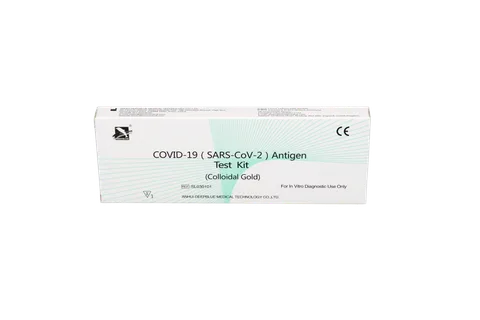 Saliva antigen rapid test kit DeepBlue
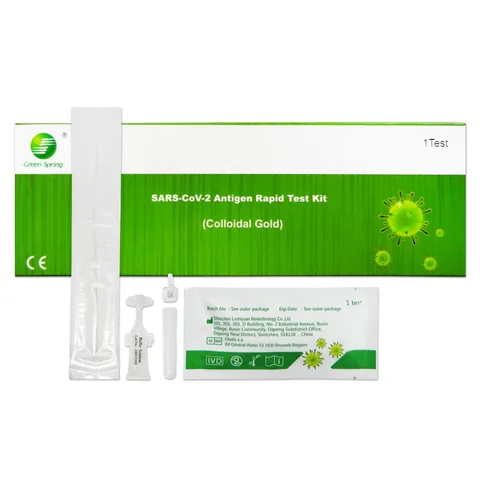 Nasal swab COVID-19 rapid test kit GREENSPRING